Thursday, March 08, 2007


Tuesday, March 06, 2007
Birthday
“She discovered with great delight that one does not love one's children just because they are one's children but because of the friendship formed while raising them.”
Gabriel Garcia Marquez eighty today
Gabriel Garcia Marquez eighty today
liverpool through to last eight
Liverpool beat Barca over two-legs
it was close

but the 2006 champions are on the way home

and arsenal can thank us for getting rid of them. Something the gooners should have done last season
it was close

but the 2006 champions are on the way home

and arsenal can thank us for getting rid of them. Something the gooners should have done last season
Blurred identities
I love the cyborg. The cyborg is my friend. When I think about them I cannot work out their gender, their race, their class; I cannot place them within a quasi-secular frame of reference, a Freudian metanarative or a Marxist mode of production. Neither is God around to save us, and I say ‘us’ deliberately because the bible never saw a cyborg before. It never saw ‘us.’ Our unities will always be too monstrous and illegitimate for the gender, race, class and religious consciousness forced on us by “the terrible historical experience of…patriarchy, colonialism and capitalism.”
The cyborgs who came to play, laugh with me at the irony of boundaries that collapse, and I whisper at them that I too am one of them. With a phone on my ear, a computer attached to my fingertips and a car as my privatised space; with a white father and black mother, with two passports and four places to call home I realise I have always been one of them. Fixation and fiction with, and of concreteness, has always been alien to me. The idea persons are more separate, than coupled and connected in millions of seen and unseen ways to things beyond-human, has always been a fairy tale.
These cyborgs, my friends, my family, are “wary of holism, but needy for connection.” We understand that singular individuals don’t exist, their minds are not Cartesian brains laid out in rows of vats. Rather, embodiment, identity and desire are forever making and remaking themselves and us – reconfiguring the eternal impermanence and energy of the cyborg mode of being in the world. Wake up! Today you can be whatever you want. Fiction is calling. Recognise your connections that are too strange to accept.
The cyborg reminds me of another body I’ve know. Delueze and Guattari’s ‘Body without Organs’ (BwO), to me, is a vision of embodiment where the fixed, reliable and easily defined discourses of social inscription given to human body parts – eyes, limbs, brains, phallus etc. is overcome, and established knowledge on the body, and hence the positioning of the universal ‘subject’ as a defined and reified entity, challenged.
Whereas the cyborg comes to save us from this universal subject, the BwO was a time before the universal subject that we have had stolen. Both bodies understand there is far more than male, female, black, white, fat, beautiful etc. and that these social ‘facts,’ -– “seductions of organic wholeness” – only allow for either/or binaries and a dialectical opposition to the other that mostly reflects a dominant and non-dominant social position unable to grasp the full extent of everyday life and experience.
Like the cyborg the BwO was never against organs, but rather the organisation of organs into an organism. Both bodies are dissatisfied with anthropological research reliant on normative categories. It is not that subject positions, agency and domination do not exist but rather when considered fixed and as elements of a close system they become repressive. We become prisoners of our own bodies, jailed within a social reality that is a political construction designed to hinder new conceptual frameworks for being, new understandings of not only persons but people – that misleading collective and homogenising noun. The cyborg and the BwO conceive of a “discourse dissolving the ‘West’ and its highest product – the one who is not animal, barbarian, or woman; man, that is the author of a cosmos called history.”
But wait I’m forgetting to tell you where my friends the cyborg come from. Did we make them, are they our children, is theirs a visit from space? The cyborg has no mother, no creation/origin myth – it is not human. It needs no mode of production; it requires no Marxist formulation of labour or necessity. Like me they are the illegitimate offspring of essentialist culture. They were not produced by fixed social positions and heterosexual parents. They are the bastard children of “militarism and patriarchal capitalism”. They have no mother and deny the existence of a million fathers. Will that be enough to let them escape and live free or are they just another reconceptualisation of masculine knowledge? Is bestiality truly “a new status in this cycle of marriage exchange”?
To redefine nature and culture is at the least subversive and at the most radically fatal to this binary. The cyborg is here to destroy the ontological flowerbed “grounding Western epistemology”. They never liked organised gardens anyways. But what of the organisation of labour, the factories, the engineers who make our post-industrial world possible, what will the cyborg do to these gardeners of social reality?
If “labour is the pre-eminently privileged category enabling the Marxist to overcome illusion and find that point of view which is necessary for changing the world [then l]abour is the humanising activity that makes man; labour is an ontological category permitting the knowledge of a subject, and so the knowledge of subjugation and alienation.” As the cyborg jumps up and down on the organised flowerbeds of man’s garden they free those who owe their existence as woman and other to Marxist analytical strategies, to sexual appropriation. They listen to Deleuze and Guattari’s desiring-production. Cyborgs make the invisible visible and put in their hands the tools “to mark the world that marked them as other,” as hidden.
The cyborgs arrived here, now, to play a part in much “needed political work.” For as one of the first to greet them said, “another of my premises is that the need for unity of people trying to resist world-wide intensification of domination has never been more acute. [And] a slightly perverse shift of perspective might better enable us to contest for meanings, as well as for other forms of power and pleasure in technologically mediated societies.”
My experience of the cyborgs is that they will help to change the world. That new lines of kinship between humans and non-humans can emerge. That contradictory standpoints, fractured identities, can be broken but we must be careful, for in their million faceless fathers, the cyborg as slave, hides a daunting age – a grid of control on the planet about the final abstraction embodied in a Star Wars apocalypse waged in the name of defence, about the final appropriation of women’s bodies in a masculinist orgy of war.”
The cyborgs are my friends because I am optimistic. I am not scared of this orgy, The limits of identities are now visible, there is a language with which to discuss them, visions within which we can try to recast how we see ourselves, our worlds, our people. The maps of power and identity written on our bodies are redefined when you, like me, understand we our both cyborgs too. That these are our friends, and that the dualisms of social reality are someone else’s story, not the cyborg’s. I too would rather be a cyborg than a goddess.
quotes taken from Donna Haraway's now classic cyborg manifesto
The cyborgs who came to play, laugh with me at the irony of boundaries that collapse, and I whisper at them that I too am one of them. With a phone on my ear, a computer attached to my fingertips and a car as my privatised space; with a white father and black mother, with two passports and four places to call home I realise I have always been one of them. Fixation and fiction with, and of concreteness, has always been alien to me. The idea persons are more separate, than coupled and connected in millions of seen and unseen ways to things beyond-human, has always been a fairy tale.
These cyborgs, my friends, my family, are “wary of holism, but needy for connection.” We understand that singular individuals don’t exist, their minds are not Cartesian brains laid out in rows of vats. Rather, embodiment, identity and desire are forever making and remaking themselves and us – reconfiguring the eternal impermanence and energy of the cyborg mode of being in the world. Wake up! Today you can be whatever you want. Fiction is calling. Recognise your connections that are too strange to accept.
The cyborg reminds me of another body I’ve know. Delueze and Guattari’s ‘Body without Organs’ (BwO), to me, is a vision of embodiment where the fixed, reliable and easily defined discourses of social inscription given to human body parts – eyes, limbs, brains, phallus etc. is overcome, and established knowledge on the body, and hence the positioning of the universal ‘subject’ as a defined and reified entity, challenged.
Whereas the cyborg comes to save us from this universal subject, the BwO was a time before the universal subject that we have had stolen. Both bodies understand there is far more than male, female, black, white, fat, beautiful etc. and that these social ‘facts,’ -– “seductions of organic wholeness” – only allow for either/or binaries and a dialectical opposition to the other that mostly reflects a dominant and non-dominant social position unable to grasp the full extent of everyday life and experience.
Like the cyborg the BwO was never against organs, but rather the organisation of organs into an organism. Both bodies are dissatisfied with anthropological research reliant on normative categories. It is not that subject positions, agency and domination do not exist but rather when considered fixed and as elements of a close system they become repressive. We become prisoners of our own bodies, jailed within a social reality that is a political construction designed to hinder new conceptual frameworks for being, new understandings of not only persons but people – that misleading collective and homogenising noun. The cyborg and the BwO conceive of a “discourse dissolving the ‘West’ and its highest product – the one who is not animal, barbarian, or woman; man, that is the author of a cosmos called history.”
But wait I’m forgetting to tell you where my friends the cyborg come from. Did we make them, are they our children, is theirs a visit from space? The cyborg has no mother, no creation/origin myth – it is not human. It needs no mode of production; it requires no Marxist formulation of labour or necessity. Like me they are the illegitimate offspring of essentialist culture. They were not produced by fixed social positions and heterosexual parents. They are the bastard children of “militarism and patriarchal capitalism”. They have no mother and deny the existence of a million fathers. Will that be enough to let them escape and live free or are they just another reconceptualisation of masculine knowledge? Is bestiality truly “a new status in this cycle of marriage exchange”?
To redefine nature and culture is at the least subversive and at the most radically fatal to this binary. The cyborg is here to destroy the ontological flowerbed “grounding Western epistemology”. They never liked organised gardens anyways. But what of the organisation of labour, the factories, the engineers who make our post-industrial world possible, what will the cyborg do to these gardeners of social reality?
If “labour is the pre-eminently privileged category enabling the Marxist to overcome illusion and find that point of view which is necessary for changing the world [then l]abour is the humanising activity that makes man; labour is an ontological category permitting the knowledge of a subject, and so the knowledge of subjugation and alienation.” As the cyborg jumps up and down on the organised flowerbeds of man’s garden they free those who owe their existence as woman and other to Marxist analytical strategies, to sexual appropriation. They listen to Deleuze and Guattari’s desiring-production. Cyborgs make the invisible visible and put in their hands the tools “to mark the world that marked them as other,” as hidden.
The cyborgs arrived here, now, to play a part in much “needed political work.” For as one of the first to greet them said, “another of my premises is that the need for unity of people trying to resist world-wide intensification of domination has never been more acute. [And] a slightly perverse shift of perspective might better enable us to contest for meanings, as well as for other forms of power and pleasure in technologically mediated societies.”
My experience of the cyborgs is that they will help to change the world. That new lines of kinship between humans and non-humans can emerge. That contradictory standpoints, fractured identities, can be broken but we must be careful, for in their million faceless fathers, the cyborg as slave, hides a daunting age – a grid of control on the planet about the final abstraction embodied in a Star Wars apocalypse waged in the name of defence, about the final appropriation of women’s bodies in a masculinist orgy of war.”
The cyborgs are my friends because I am optimistic. I am not scared of this orgy, The limits of identities are now visible, there is a language with which to discuss them, visions within which we can try to recast how we see ourselves, our worlds, our people. The maps of power and identity written on our bodies are redefined when you, like me, understand we our both cyborgs too. That these are our friends, and that the dualisms of social reality are someone else’s story, not the cyborg’s. I too would rather be a cyborg than a goddess.
quotes taken from Donna Haraway's now classic cyborg manifesto
White Trash
"What that says about modern Britain seems pretty straightforward. How else to understand it than as more evidence of our embrace of an increasingly American social model, in which there is opportunity for all - apart from the undeserving rump too feckless to seize it? In short, we've finally acquired our own equivalent of that dread term "white trash". As Lynsey Hanley's superb book Estates - superficially about council housing, but actually addressing much more - points out, at the bottom of the social ladder, class has been supplanted by caste, thanks to a con trick whereby successive governments have "hived off poorer working-class people from affluent society ... when, all the while, they have claimed that we are progressing inexorably towards a state of classlessness".
more
more
Friday, March 02, 2007
Tuesday, February 27, 2007
Saturday, February 24, 2007
Smuggling
"A former public schoolboy who masterminded a £3m plot to smuggle wooden doors impregnated with liquid cocaine into Britain was jailed yesterday for 18 years. Paul Sneath, 24, of Guildford, Surrey, came up with a "unique" plot using sheets of plywood, liquid cocaine, industrial solvent, and cheese graters.
In 2005, after inheriting £250,000, the Bristol University dropout travelled to Panama where he arranged for plywood to be soaked in liquid cocaine and sealed inside doors elaborately patterned with parrots. The doors were then shipped from Panama to his family home, where his unknowing mother signed for them and paid £798 for the shipping costs.
Sneath then transferred the doors to a lock-up in Dalston, east London, where members of a Colombian gang removed the plywood, shaved it with cheese graters and mixed the shavings with heated solvent. Police caught the gang red-handed before they had a chance to dry the precipitate and chop it into powder. The doors were found to have been impregnated with 17.3kg of pure cocaine, with a street value in excess of £3.2m.
Sneath, who had no previous criminal record, was found guilty of conspiracy to supply cocaine at Inner London crown court."
more
In 2005, after inheriting £250,000, the Bristol University dropout travelled to Panama where he arranged for plywood to be soaked in liquid cocaine and sealed inside doors elaborately patterned with parrots. The doors were then shipped from Panama to his family home, where his unknowing mother signed for them and paid £798 for the shipping costs.
Sneath then transferred the doors to a lock-up in Dalston, east London, where members of a Colombian gang removed the plywood, shaved it with cheese graters and mixed the shavings with heated solvent. Police caught the gang red-handed before they had a chance to dry the precipitate and chop it into powder. The doors were found to have been impregnated with 17.3kg of pure cocaine, with a street value in excess of £3.2m.
Sneath, who had no previous criminal record, was found guilty of conspiracy to supply cocaine at Inner London crown court."
more
Friday, February 23, 2007
Torture in the US
"Something remarkable is going on in a Miami courtroom. The cruel methods US interrogators have used since September 11 to "break" prisoners are finally being put on trial. This was not supposed to happen. The Bush administration's plan was to put José Padilla on trial for allegedly being part of a network linked to international terrorists. But Padilla's lawyers are arguing that he is not fit to stand trial because he has been driven insane by the government.
Arrested in May 2002 at Chicago's O'Hare airport, Padilla, a Brooklyn-born former gang member, was classified as an "enemy combatant" and taken to a navy prison in Charleston, South Carolina. He was kept in a cell 9ft by 7ft, with no natural light, no clock and no calendar. Whenever Padilla left the cell, he was shackled and suited in heavy goggles and headphones. Padilla was kept under these conditions for 1,307 days. He was forbidden contact with anyone but his interrogators, who punctured the extreme sensory deprivation with sensory overload, blasting him with harsh lights and pounding sounds. Padilla also says he was injected with a "truth serum", a substance his lawyers believe was LSD or PCP."
more
Arrested in May 2002 at Chicago's O'Hare airport, Padilla, a Brooklyn-born former gang member, was classified as an "enemy combatant" and taken to a navy prison in Charleston, South Carolina. He was kept in a cell 9ft by 7ft, with no natural light, no clock and no calendar. Whenever Padilla left the cell, he was shackled and suited in heavy goggles and headphones. Padilla was kept under these conditions for 1,307 days. He was forbidden contact with anyone but his interrogators, who punctured the extreme sensory deprivation with sensory overload, blasting him with harsh lights and pounding sounds. Padilla also says he was injected with a "truth serum", a substance his lawyers believe was LSD or PCP."
more
Thursday, February 22, 2007
Wednesday, February 21, 2007

Tuesday, February 20, 2007
Teaching the machine
“I was trying to explain this stuff in the traditional paper format, and I thought, ‘This is ironic,’ I can illustrate this much better in a video.”
michael wesch, assistant professor of cultural anthropology and digital ethnographer
Sunday, February 18, 2007
William Blake
To see a World in a Grain of Sand
And a Heaven in a Wild Flower:
Hold Infinity in the palm of your hand
And Eternity in an hour.
And a Heaven in a Wild Flower:
Hold Infinity in the palm of your hand
And Eternity in an hour.
Saturday, February 17, 2007
CLR James on Kanhai
"Cricket is an art, a means of national expression. Voltaire says that no one is so boring as the man who insists on saying everything. I have said enough. But I believe I owe it to the many who did not see the Edgbaston innings to say what I thought it showed of the directions that, once freed, the West Indies might take. The West Indies in my view embody more sharply than elsewhere Nietzche’s conflict between the ebullience of Dionysus and the discipline of Apollo. Kanhai’s going crazy might seem to be Dionysus in us breaking loose. It was absent from Edgbaston. Instead the phrases which go nearest to expressing what I saw and have reflected upon are those of Lytton Strachey on French Literature: ‘(the) mingled distinction, gaiety and grace which is one of the unique products of the mature poetical genius of France.’
Distinction, gaiety, grace. Virtues of the ancient Eastern Mediterranean, city-states, islands, the sea, and the sun. Long before Edgbaston I had been thinking that way. Maybe I saw only what I was looking for. Maybe."
more
Distinction, gaiety, grace. Virtues of the ancient Eastern Mediterranean, city-states, islands, the sea, and the sun. Long before Edgbaston I had been thinking that way. Maybe I saw only what I was looking for. Maybe."
more
Let the party begin
"Amid a delightful cacophony of Caribbean sounds symbolising national rejoicing, the new Kensington Oval was officially unveiled yesterday. It also marked the unofficial opening of the ninth World Cup. The official ceremony is at Sabina Park, Kingston, on 11 March, but there was the definite whiff of a march being stolen. The 2007 Kensington Oval is a tremendous arena, fit for a World Cup final, which it will stage late in April. Yesterday, it was perfectly content with a festival match between a West Indies Legends XI and a Rest of the World XI. It was a treat. The statue of Sir Garfield Sobers outside the ground, unveiled by the great man himself, said it all."
cricket world cup
cricket world cup

Friday, February 16, 2007
Property
"The first man who, having enclosed a piece of land, thought of saying 'This is mine' and found people simple enough to believe him, was the true founder of civil society. How many crimes, wars, murders; how much misery and horror the human race would have been spared if someone had pulled up the stakes and filled in the ditch and cried out to his fellow men: 'Beware of listening to this imposter. Youare lost if you forget that the fruits of the earth belong to everyone and that the earth itself belongs to no one!"
Jean-Jacques Rousseau
Jean-Jacques Rousseau
Tuesday, February 13, 2007
Chagon, Tierney, Neel and the Yanomani
This is most balanced article i've read on the 'Darkness in El Dorado' issues that haunt anthropology.
"Anthropologists cannot simply be observers, as traditional scientific objectivity requires, but must actively take sides in any political struggle involving the peoples they are studying. And in such a struggle the norms of scientific objectivity become subordinate to the political aims."
more
"Anthropologists cannot simply be observers, as traditional scientific objectivity requires, but must actively take sides in any political struggle involving the peoples they are studying. And in such a struggle the norms of scientific objectivity become subordinate to the political aims."
more
Thursday, February 08, 2007
confusion
"A team of world-leading neuroscientists has developed a powerful technique that allows them to look deep inside a person's brain and read their intentions before they act.
The research breaks controversial new ground in scientists' ability to probe people's minds and eavesdrop on their thoughts, and raises serious ethical issues over how brain-reading technology may be used in the future.
The team used high-resolution brain scans to identify patterns of activity before translating them into meaningful thoughts, revealing what a person planned to do in the near future. It is the first time scientists have succeeded in reading intentions in this way.
"Using the scanner, we could look around the brain for this information and read out something that from the outside there's no way you could possibly tell is in there. It's like shining a torch around, looking for writing on a wall," said John-Dylan Haynes at the Max Planck Institute for Human Cognitive and Brain Sciences in Germany, who led the study with colleagues at University College London and Oxford University."
more
The research breaks controversial new ground in scientists' ability to probe people's minds and eavesdrop on their thoughts, and raises serious ethical issues over how brain-reading technology may be used in the future.
The team used high-resolution brain scans to identify patterns of activity before translating them into meaningful thoughts, revealing what a person planned to do in the near future. It is the first time scientists have succeeded in reading intentions in this way.
"Using the scanner, we could look around the brain for this information and read out something that from the outside there's no way you could possibly tell is in there. It's like shining a torch around, looking for writing on a wall," said John-Dylan Haynes at the Max Planck Institute for Human Cognitive and Brain Sciences in Germany, who led the study with colleagues at University College London and Oxford University."
more
Wednesday, February 07, 2007
Oh no you didn't
"The US flew nearly $12bn in shrink-wrapped $100 bills into Iraq, then distributed the cash with no proper control over who was receiving it and how it was being spent.
The staggering scale of the biggest transfer of cash in the history of the Federal Reserve has been graphically laid bare by a US congressional committee.
In the year after the invasion of Iraq in 2003 nearly 281 million notes, weighing 363 tonnes, were sent from New York to Baghdad for disbursement to Iraqi ministries and US contractors. Using C-130 planes, the deliveries took place once or twice a month with the biggest of $2,401,600,000 on June 22 2004, six days before the handover.
Details of the shipments have emerged in a memorandum prepared for the meeting of the House committee on oversight and government reform which is examining Iraqi reconstruction. Its chairman, Henry Waxman, a fierce critic of the war, said the way the cash had been handled was mind-boggling. "The numbers are so large that it doesn't seem possible that they're true. Who in their right mind would send 363 tonnes of cash into a war zone?"
more
The staggering scale of the biggest transfer of cash in the history of the Federal Reserve has been graphically laid bare by a US congressional committee.
In the year after the invasion of Iraq in 2003 nearly 281 million notes, weighing 363 tonnes, were sent from New York to Baghdad for disbursement to Iraqi ministries and US contractors. Using C-130 planes, the deliveries took place once or twice a month with the biggest of $2,401,600,000 on June 22 2004, six days before the handover.
Details of the shipments have emerged in a memorandum prepared for the meeting of the House committee on oversight and government reform which is examining Iraqi reconstruction. Its chairman, Henry Waxman, a fierce critic of the war, said the way the cash had been handled was mind-boggling. "The numbers are so large that it doesn't seem possible that they're true. Who in their right mind would send 363 tonnes of cash into a war zone?"
more
Sunday, February 04, 2007
Saturday, February 03, 2007
immanence
From GU
"Anyone ready for a vegetable Spinoza?
In the West, the clash of civilisations is not between Islam and Christianity, but two other powerful faiths: environmentalism and materialism. Observe the reverence of worshippers at a Ferrari showroom and a farmers' market. A Testarossa or an organic carrot? Both are so eulogised by these rival flocks they could be the Second Coming. 'Greed is good' proved a slogan too powerful for that lesser faith, socialism. Now materialism faces a fresh challenge from a creed with a new motto: 'Green is good'.
Environmentalism is a faith, its converts as fervent as those flocking to Islam. The West might have shaken off God, but not the desire to revere: the planet. Don't believe me? Read Baruch Spinoza. He lived in 17th-century Amsterdam, but is rapidly becoming philosopher a la mode. He even dabbled in kabbalah: how modish is that?
He believed the world is God. So to pray is to worship every hill and valley, every raindrop and sunray, every man and animal - and every law connecting them. It was known as pantheism, but could be called environmentalism. Without Spinoza, would we ever have heard of James Lovelock and Gaia?
Since Descartes, humanity has felt itself separate from a dead, physical world that is ours to play with. Spinoza, by contrast, says we are part of the same, sacred earth. What makes us special? According to Spinoza, nowt. Which is very green. Unlike Prince Charles, Spinoza was a frugal ecologist.
What we call greed, Spinoza called 'human bondage'. He distrusted desire and progress. But he was a democrat who wanted the clergy out of politics. Many greens will also identify with his years of ostracism: aged 23, he was excommunicated by his synagogue for 'abominable heresies'. His great works were published after his death, found hidden in his desk. He is interesting as more than an historical curiosity, however.
He wrote: 'Like waves on the sea, driven by contrary winds, we toss about, not knowing our fate.' A pretty good take on life with rising sea levels. He also felt nature is determined to 'produce an effect in a certain way'. If only Bush had read that before commissioning dodgy reports suggesting climate change is mere chance.
But Spinoza would also ask tough questions of greens: is yours a faith in the planet or merely a lifestyle choice?
So will Spinoza triumph? Capitalism always adapts, hence all the products pushed as 'green'. Spinoza would choose the carrot over the Ferrari. Will we?"
"Anyone ready for a vegetable Spinoza?
In the West, the clash of civilisations is not between Islam and Christianity, but two other powerful faiths: environmentalism and materialism. Observe the reverence of worshippers at a Ferrari showroom and a farmers' market. A Testarossa or an organic carrot? Both are so eulogised by these rival flocks they could be the Second Coming. 'Greed is good' proved a slogan too powerful for that lesser faith, socialism. Now materialism faces a fresh challenge from a creed with a new motto: 'Green is good'.
Environmentalism is a faith, its converts as fervent as those flocking to Islam. The West might have shaken off God, but not the desire to revere: the planet. Don't believe me? Read Baruch Spinoza. He lived in 17th-century Amsterdam, but is rapidly becoming philosopher a la mode. He even dabbled in kabbalah: how modish is that?
He believed the world is God. So to pray is to worship every hill and valley, every raindrop and sunray, every man and animal - and every law connecting them. It was known as pantheism, but could be called environmentalism. Without Spinoza, would we ever have heard of James Lovelock and Gaia?
Since Descartes, humanity has felt itself separate from a dead, physical world that is ours to play with. Spinoza, by contrast, says we are part of the same, sacred earth. What makes us special? According to Spinoza, nowt. Which is very green. Unlike Prince Charles, Spinoza was a frugal ecologist.
What we call greed, Spinoza called 'human bondage'. He distrusted desire and progress. But he was a democrat who wanted the clergy out of politics. Many greens will also identify with his years of ostracism: aged 23, he was excommunicated by his synagogue for 'abominable heresies'. His great works were published after his death, found hidden in his desk. He is interesting as more than an historical curiosity, however.
He wrote: 'Like waves on the sea, driven by contrary winds, we toss about, not knowing our fate.' A pretty good take on life with rising sea levels. He also felt nature is determined to 'produce an effect in a certain way'. If only Bush had read that before commissioning dodgy reports suggesting climate change is mere chance.
But Spinoza would also ask tough questions of greens: is yours a faith in the planet or merely a lifestyle choice?
So will Spinoza triumph? Capitalism always adapts, hence all the products pushed as 'green'. Spinoza would choose the carrot over the Ferrari. Will we?"
changing sides
Fukuyama says. "When I wrote The End of History, I did not anticipate the degree to which mistakes on the part of American leaders, in their own stewardship of American power, could create such problems and undermine the legitimacy of the broader project. I don't think these are mistakes we'll never recover from ... but there's no question that because of decisions in Washington, the situation has become much worse than it would have been."
more
more
Friday, February 02, 2007
Thursday, February 01, 2007

Wednesday, January 31, 2007
Stop the carnival
"People develop a country, not industrial plants, overhead railways or palaces. And Trinidad and Tobago's people are beginning to understand that they have been let down by every post-independence government. Their political parties are discredited or untested. I keep wondering, where will they turn now?"
jeremy taylor: Stop the carnival
jeremy taylor: Stop the carnival

Cheesy perhaps, but true for me today
One evening an old Cherokee told his grandson
about a battle that goes on inside people.
He said, "My son, the battle is between two
’wolves’ inside us all”.
One is Evil. It is anger, envy, jealousy, sorrow,
regret, greed, arrogance, self-pity, guilt, resentment,
inferiority, lies, false pride, superiority, and ego.
The other is Good. It is joy, peace, love, hope, serenity, humility,
kindness, benevolence, empathy, generosity, truth, compassion and
faith."
The grandson thought about it for a minute and then asked his
grandfather: “Which wolf wins?"
The grandfather replies: “The one you feed”.
about a battle that goes on inside people.
He said, "My son, the battle is between two
’wolves’ inside us all”.
One is Evil. It is anger, envy, jealousy, sorrow,
regret, greed, arrogance, self-pity, guilt, resentment,
inferiority, lies, false pride, superiority, and ego.
The other is Good. It is joy, peace, love, hope, serenity, humility,
kindness, benevolence, empathy, generosity, truth, compassion and
faith."
The grandson thought about it for a minute and then asked his
grandfather: “Which wolf wins?"
The grandfather replies: “The one you feed”.
Arundhati Roy in 2003
"the disparity between the rich and poor grows, the fight to corner resources is intensifying. To push through their 'sweetheart deals,' to corporatize the crops we grow, the water we drink, the air we breathe, and the dreams we dream, coporate globalisation needs an international confederation of loyal, corrupt, authoritarian governments in poorer countries to push through unpopular reforms and quell the mutinies.
Coporate Globalisation – or shall we call it by its name? Imperialism – needs a press that pretends to be free. it needs courts that pretend to dispense justice.
Meanwhile, the countries of the North harden their corders and stockpile weapons of mass destruction. After all they have to make sure that it's only money, goods, patents and services that are globalised. Not the free movement of people. Not a respect for human rights. Not international treaties on racial discrimination or chemical and nuclear weapons or greenhouse gas emissions or climate change, or – God forbid – justice. So this, all this, is 'empire.' this loyal confederation, this obscene acumulation of power, this greatly increased distance between those who make the decisions and those who have to suffer them."
Coporate Globalisation – or shall we call it by its name? Imperialism – needs a press that pretends to be free. it needs courts that pretend to dispense justice.
Meanwhile, the countries of the North harden their corders and stockpile weapons of mass destruction. After all they have to make sure that it's only money, goods, patents and services that are globalised. Not the free movement of people. Not a respect for human rights. Not international treaties on racial discrimination or chemical and nuclear weapons or greenhouse gas emissions or climate change, or – God forbid – justice. So this, all this, is 'empire.' this loyal confederation, this obscene acumulation of power, this greatly increased distance between those who make the decisions and those who have to suffer them."
Tuesday, January 30, 2007
Scientists ‘pressured’ to play down climate risk
"TWO private advocacy groups told a US congressional hearing yesterday that climate scientists at seven government agencies say they have been subjected to political pressure aimed at playing down the threat of global warming."
more
more
Making money kills people
"Novartis filed an appeal in Madras, India, against a decision to prevent it from patenting a new version of leukemia drug Gleevac, whose patent expired.
If the company wins its case, Indian companies could be banned from making generic versions of the drug, sold around the world for about 1-10th of the $2,600 price for a month`s supply Novartis charges, The International Herald Tribune reported.
'Novartis is trying to shut down the pharmacy of the developing world,' Doctors Without Borders` Campaign for Access to Essential Medicine Medical Director Unni Karunakara said at a New Delhi news conference.
'Indian drugs form the backbone of our AIDS programs in which 80,000 people in over 30 counties receive treatment,' he said. 'Over 80 percent of the medicines we use to treat AIDS come from India.'
Doctors Without Borders and Oxfam International have collected nearly 250,000 signatures on a petition asking Novartis to drop the case.
A 2005 Indian patent law lets patents be granted on new versions of older drugs whose patents have expired if the new version can be shown to represent a significant improvement on the original."
more
If the company wins its case, Indian companies could be banned from making generic versions of the drug, sold around the world for about 1-10th of the $2,600 price for a month`s supply Novartis charges, The International Herald Tribune reported.
'Novartis is trying to shut down the pharmacy of the developing world,' Doctors Without Borders` Campaign for Access to Essential Medicine Medical Director Unni Karunakara said at a New Delhi news conference.
'Indian drugs form the backbone of our AIDS programs in which 80,000 people in over 30 counties receive treatment,' he said. 'Over 80 percent of the medicines we use to treat AIDS come from India.'
Doctors Without Borders and Oxfam International have collected nearly 250,000 signatures on a petition asking Novartis to drop the case.
A 2005 Indian patent law lets patents be granted on new versions of older drugs whose patents have expired if the new version can be shown to represent a significant improvement on the original."
more
Racism, Class Inequality, and the Politics of Recognition
"The 'cunning of recognition', as Elizabeth Povinelli describes this maneuver of power, does not refuse to recognize past atrocities committed by the liberal state, but acknowledges the horror of these actions--e.g., slavery, genocide, segregation, and apartheid--in order to secure and reinvigorate the future of the liberal nation-state and its core values (Povinelli 2002: 29). In short, liberal forms of multi-culturalism use national rituals of apology for the past mistreatment of subordinated and oppressed members of society not to transfer power or to change society but to re-create the national form.
Racial reforms--from attempts at reconciliation in Australia, to civil rights in the US, to the Truth and Reconciliation Commission in South Africa--function as narratives of national redemption, maintaining (and sometimes inventing) racial cleavages along the way (see Dominguez 1994). What surprise, then, that 'racial reform' has overlapped--if not conspired--with neo-conservative assaults on the welfare state that have gutted the very institutions that were supposed to remedy these inequalities (Baca 2004; see Prashad in this issue). Such co-existence of racial reform with the deepening of racial and class inequality is not as anomalous as some commentators suggest (e.g., Holt 2000: 5-7). Instead, the manner in which racial reforms complement racializing discourse illustrates the politics of nationalism, which requires that we theorize the relationship between the racist content of neo-liberal reforms and the rise of multi-culturalism (Baca 2003)."
more
Racial reforms--from attempts at reconciliation in Australia, to civil rights in the US, to the Truth and Reconciliation Commission in South Africa--function as narratives of national redemption, maintaining (and sometimes inventing) racial cleavages along the way (see Dominguez 1994). What surprise, then, that 'racial reform' has overlapped--if not conspired--with neo-conservative assaults on the welfare state that have gutted the very institutions that were supposed to remedy these inequalities (Baca 2004; see Prashad in this issue). Such co-existence of racial reform with the deepening of racial and class inequality is not as anomalous as some commentators suggest (e.g., Holt 2000: 5-7). Instead, the manner in which racial reforms complement racializing discourse illustrates the politics of nationalism, which requires that we theorize the relationship between the racist content of neo-liberal reforms and the rise of multi-culturalism (Baca 2003)."
more
Platini
"The French midfielder has never strayed too far from my thoughts where football is concerned, because he was the most beautiful player I ever saw in the flesh; yes, more beautiful even than Johan Cruyff, Zinédine Zidane or George Best. And although beauty may not save the world, it certainly makes life worth living."
more
more
Monday, January 29, 2007
tick tock tick tock
Mr Bush, in an interview with National Public Radio, said yesterday: "If Iran escalates its military action in Iraq to the detriment of our troops and/or innocent Iraqi people, we will respond firmly."
more
more
Sunday, January 28, 2007

Brass festival goes dancehall
changing times
"Brass Festival, as it is traditionally known has been expanded in the 2007 edition to make room for Jamaican dancehall stars Richie Spice and Elephant Man. The latter is due to perform with double Road March winner and reigning Soca Monarch Shurwayne Winchester with whom he has released a special track for the Carnival period. Winchester and his band Traffik will also deliver a full-length concert set at the fete which is this year celebrating, its eighteenth anniversary."
read more
"Brass Festival, as it is traditionally known has been expanded in the 2007 edition to make room for Jamaican dancehall stars Richie Spice and Elephant Man. The latter is due to perform with double Road March winner and reigning Soca Monarch Shurwayne Winchester with whom he has released a special track for the Carnival period. Winchester and his band Traffik will also deliver a full-length concert set at the fete which is this year celebrating, its eighteenth anniversary."
read more
Saturday, January 27, 2007
Jacques Mayol
"A French national born in Shanghais China in 1927, Jacques Mayol was known as the ‘Dolphin Man’ due to his underwater exploits in the field of free diving along with the special relationships he developed with dolphins.
Mayol’s fascination with the sea arose from a close friendship with a dolphin named Clown at the Seaquarium in Miami, Florida, where he was sent from Radio Canada as a journalist to both research an article and produce an audio piece. The director of Programs and Events at the Seaquarium invited him to stay. Mayol accepted and began working on the maintenance of the tanks and the dietary concerns of the various marine creatures. At the same time, he was also given permission to dive in the big tank with all of the dolphins including one destined to become his special friend, Clown.
Clown taught Mayol how to hold his breath longer on every dive, how to behave underwater, and how to integrate himself with the water totally and finally, how to laugh inside. Thanks to these lessons, he also integrated the powers of Yoga and Oriental philosophies with his dive skills, disciplines he first became aware of while growing up in Japan. This emotional and psychological discipline opened the path that led to his record setting 100 meter dive."
read more
Mayol’s fascination with the sea arose from a close friendship with a dolphin named Clown at the Seaquarium in Miami, Florida, where he was sent from Radio Canada as a journalist to both research an article and produce an audio piece. The director of Programs and Events at the Seaquarium invited him to stay. Mayol accepted and began working on the maintenance of the tanks and the dietary concerns of the various marine creatures. At the same time, he was also given permission to dive in the big tank with all of the dolphins including one destined to become his special friend, Clown.
Clown taught Mayol how to hold his breath longer on every dive, how to behave underwater, and how to integrate himself with the water totally and finally, how to laugh inside. Thanks to these lessons, he also integrated the powers of Yoga and Oriental philosophies with his dive skills, disciplines he first became aware of while growing up in Japan. This emotional and psychological discipline opened the path that led to his record setting 100 meter dive."
read more
Thursday, January 25, 2007
Wednesday, January 24, 2007
Trinidad: Four killed to stop cops from testifying
"The cold-blooded murders of Woman Police Constable Elizabeth Sutherland, her husband Ivan and daughter Anika was a warning to all police officers involved in various matters against a known gang leader and his relatives.
Police sources said yesterday that the execution of the Sutherlands and family friend Kevin Serrette on Monday night was a message to officers who had testified in matters against the gang: "Testify against us and die."
read more
Police sources said yesterday that the execution of the Sutherlands and family friend Kevin Serrette on Monday night was a message to officers who had testified in matters against the gang: "Testify against us and die."
read more
Does Bush even care?
"The war's costs to our nation have been staggering," he said. "Financially. The damage to our reputation around the world. The lost opportunities to defeat the forces of international terrorism, and especially the precious blood of our citizens who have stepped forward to serve."
Then Mr Webb went for the jugular, calling on Mr Bush to embark on a new programme of diplomacy to try to bring the war to an end. "The majority of the nation no longer supports the way this war is being fought; nor does the majority of our military," he said. "We need a new direction."
read more
Then Mr Webb went for the jugular, calling on Mr Bush to embark on a new programme of diplomacy to try to bring the war to an end. "The majority of the nation no longer supports the way this war is being fought; nor does the majority of our military," he said. "We need a new direction."
read more
Tuesday, January 23, 2007

Saturday, January 20, 2007
Put him on the stand!
Maybe its more bacchanal for many, but for me i think its well passed time that Prime Minister Manning was cross-examined in court. He rules with little scrutiny and is able to destroy characters with little evidence that stands by itself. Manning's decision to impeach Sharma was murky to say the least. I doubt his appearance in court will change much, Manning already has too much power, however it will make his dirty laundry more public. booo to manning. he smells.
read about the issue here
read about the issue here
Read better
"I have tried to make a case for the special role of writer-critics, as it is in my interest to do. There is a suspicion that writers who become critics retain too much of the sentiment and mysticism of their craft to be capable of real critical thought - maybe I am evidence of that. But Roland Barthes is a good exception to that rule; he had both a sensuous understanding of the creative artist and an unimpeachable critical skill. Most of all, he understood that the critic's job is a non-cynical truth-seeking exercise, deeply connected to the critic's own beliefs, values and failures. "Each critic," he says, "chooses his necessary language, in accordance with a certain existential pattern, as the means of exercising an intellectual function which is his, and his alone ... he puts into the operation his 'deepest self', that is, his preferences, pleasures, resistances, and obsessions."
read more
read more
Tuesday, January 16, 2007
Borat at the golden globes
"This movie was a life-changing experience," Cohen said. "I saw some amazing, beautiful, invigorating parts of America, but I saw some dark parts of America, an ugly side of America, a side of America that rarely sees the light of day. I refer of course to the anus and testicles of my co-star, Ken Davitian."
The fat one sat at his table watching the skinny one and swigging from a bottle of wine. "Ken, when I was in that scene and I stared down and saw your two wrinkled golden globes on my chin, I thought to myself, 'I'd better win a bloody award for this'."
read more
The fat one sat at his table watching the skinny one and swigging from a bottle of wine. "Ken, when I was in that scene and I stared down and saw your two wrinkled golden globes on my chin, I thought to myself, 'I'd better win a bloody award for this'."
read more
Monday, January 15, 2007

Ian Smart on Slavery
"William's work shows that the British moved early in the nineteenth century to abolish first the slave trade and then the hateful institution itself not for humanitarian considerations but purely for economic reasons. The British mercantile capitalists, who had generated immense wealth through the trans-Atlantic slave trade, the triangular trade, and the plantation economy, had fallen from grace at home. The new power brokers were the capitalists who controlled the Indian subcontinent. There was no need for slavery in that region of the globe, where dirt cheap and very expendable 'free' labour abounded."
from 'Willie Lynch to the World Trade Center'
from 'Willie Lynch to the World Trade Center'
Sunday, January 14, 2007
MIT Open course ware
Lecture notes, reading lists, discussion aids - MIT has put loads of their courses online. The resource is phenomenal. use or just peruse. Well worth a visit.
Saturday, January 13, 2007
Fail better
Throughly interesting piece by Zadie Smith (ex-Hampstead girl too) on failing to write
"Map of disappointments - Nabokov would call that a good title for a bad novel. It strikes me as a suitable guide to the land where writers live, a country I imagine as mostly beach, with hopeful writers standing on the shoreline while their perfect novels pile up, over on the opposite coast, out of reach. Thrusting out of the shoreline are hundreds of piers, or "disappointed bridges", as Joyce called them. Most writers, most of the time, get wet. Why they get wet is of little interest to critics or readers, who can only judge the soggy novel in front of them. But for the people who write novels, what it takes to walk the pier and get to the other side is, to say the least, a matter of some importance. To writers, writing well is not simply a matter of skill, but a question of character. What does it take, after all, to write well? What personal qualities does it require? What personal resources does a bad writer lack? In most areas of human endeavour we are not shy of making these connections between personality and capacity. Why do we never talk about these things when we talk about books?"
read more
"Map of disappointments - Nabokov would call that a good title for a bad novel. It strikes me as a suitable guide to the land where writers live, a country I imagine as mostly beach, with hopeful writers standing on the shoreline while their perfect novels pile up, over on the opposite coast, out of reach. Thrusting out of the shoreline are hundreds of piers, or "disappointed bridges", as Joyce called them. Most writers, most of the time, get wet. Why they get wet is of little interest to critics or readers, who can only judge the soggy novel in front of them. But for the people who write novels, what it takes to walk the pier and get to the other side is, to say the least, a matter of some importance. To writers, writing well is not simply a matter of skill, but a question of character. What does it take, after all, to write well? What personal qualities does it require? What personal resources does a bad writer lack? In most areas of human endeavour we are not shy of making these connections between personality and capacity. Why do we never talk about these things when we talk about books?"
read more

here we go again
New years resolution:
hmmm, still thinking,
but more sun, friends and family in my life seems like a good one.
Lets start this blogging thing over again...

hmmm, still thinking,
but more sun, friends and family in my life seems like a good one.
Lets start this blogging thing over again...

Friday, December 15, 2006
Alice Walker
"Walker has no intention of retiring but tells me that, "In the tradition of the world when people reach their 60s, they withdraw. They become sages ... In South Korea they believe that when you turn 60, you've become a baby again and the rest of your life should be totally about joy and happiness and people should leave you alone and I just think that that's the height of intelligence. It's about strategically understanding that you need to retreat."
read more
read more
Arundhati Roy
"For all these reasons it is critical that we consider carefully the strange, sad and utterly sinister story of the December 13 attack. It tells us a great deal about the way the world's largest "democracy" really works. It connects the biggest things to the smallest. It traces the pathways that connect what happens in the shadowy grottoes of our police stations to what goes on in the snowy streets of Paradise Valley, and from there to the malign furies that bring nations to the brink of nuclear war. It raises specific questions that deserve specific, and not ideological or rhetorical, answers. What hangs in the balance is far more than the fate of one man."
read more
read more
Wednesday, December 13, 2006
Liverpool FC
"Liverpool was one of the few clubs originally formed as a commercial venture. John Houlding, a brewer, was left with an empty Anfield in 1892 after Everton left protesting about the rent. He hired 11 Scots, all professionals, the "team of Macs," to fill Anfield and make money.
Critics of modern football's turbo-capitalism look to an ideal where clubs are member-owned and the money is shared more evenly. Liverpool fans are more immediately concerned not to fall further behind Chelsea, Manchester United and Arsenal and so far they appear persuaded that their heritage is not being sold. This was poetically expressed last week by one fan on the Red All Over the Land fanzine website:
"If you think old Shanks'd be turning in his grave, think again, get a grip lad, you're wrong. Behave!"
read more
Critics of modern football's turbo-capitalism look to an ideal where clubs are member-owned and the money is shared more evenly. Liverpool fans are more immediately concerned not to fall further behind Chelsea, Manchester United and Arsenal and so far they appear persuaded that their heritage is not being sold. This was poetically expressed last week by one fan on the Red All Over the Land fanzine website:
"If you think old Shanks'd be turning in his grave, think again, get a grip lad, you're wrong. Behave!"
read more
Tuesday, December 12, 2006

Sunday, December 10, 2006
Social Business
The Nobel Lecture given by The Nobel Peace Prize Laureate 2006, Muhammad Yunus (Oslo, December 10, 2006)
An excerpt:
"By defining "entrepreneur" in a broader way we can change the character of capitalism radically, and solve many of the unresolved social and economic problems within the scope of the free market. Let us suppose an entrepreneur, instead of having a single source of motivation (such as, maximizing profit), now has two sources of motivation, which are mutually exclusive, but equally compelling a) maximization of profit and b) doing good to people and the world.
Each type of motivation will lead to a separate kind of business. Let us call the first type of business a profit-maximizing business, and the second type of business as social business.
Social business will be a new kind of business introduced in the market place with the objective of making a difference in the world. Investors in the social business could get back their investment, but will not take any dividend from the company. Profit would be ploughed back into the company to expand its outreach and improve the quality of its product or service. A social business will be a non-loss, non-dividend company.
Once social business is recognized in law, many existing companies will come forward to create social businesses in addition to their foundation activities. Many activists from the non-profit sector will also find this an attractive option. Unlike the non-profit sector where one needs to collect donations to keep activities going, a social business will be self-sustaining and create surplus for expansion since it is a non-loss enterprise. Social business will go into a new type of capital market of its own, to raise capital.
Young people all around the world, particularly in rich countries, will find the concept of social business very appealing since it will give them a challenge to make a difference by using their creative talent. Many young people today feel frustrated because they cannot see any worthy challenge, which excites them, within the present capitalist world. Socialism gave them a dream to fight for. Young people dream about creating a perfect world of their own."
An excerpt:
"By defining "entrepreneur" in a broader way we can change the character of capitalism radically, and solve many of the unresolved social and economic problems within the scope of the free market. Let us suppose an entrepreneur, instead of having a single source of motivation (such as, maximizing profit), now has two sources of motivation, which are mutually exclusive, but equally compelling a) maximization of profit and b) doing good to people and the world.
Each type of motivation will lead to a separate kind of business. Let us call the first type of business a profit-maximizing business, and the second type of business as social business.
Social business will be a new kind of business introduced in the market place with the objective of making a difference in the world. Investors in the social business could get back their investment, but will not take any dividend from the company. Profit would be ploughed back into the company to expand its outreach and improve the quality of its product or service. A social business will be a non-loss, non-dividend company.
Once social business is recognized in law, many existing companies will come forward to create social businesses in addition to their foundation activities. Many activists from the non-profit sector will also find this an attractive option. Unlike the non-profit sector where one needs to collect donations to keep activities going, a social business will be self-sustaining and create surplus for expansion since it is a non-loss enterprise. Social business will go into a new type of capital market of its own, to raise capital.
Young people all around the world, particularly in rich countries, will find the concept of social business very appealing since it will give them a challenge to make a difference by using their creative talent. Many young people today feel frustrated because they cannot see any worthy challenge, which excites them, within the present capitalist world. Socialism gave them a dream to fight for. Young people dream about creating a perfect world of their own."
Microfinance
'we must address the root causes of terrorism to end it for all time to come. I believe that putting resources into improving the lives of the poor people is a better strategy than spending it on guns.'
- Muhammad Yunus, founder of the Grameen Movement micro-banking system and 2006 Nobel Peace Prize winner
- Muhammad Yunus, founder of the Grameen Movement micro-banking system and 2006 Nobel Peace Prize winner
Friday, December 08, 2006
Class warfare
below is a long article but its worth reading. it is a prime example of the way global capitalism dispossessess the lands, rights and resources of local people in order to increase accumulation of capital for a silent ruling class who already make and are in total control of loads of cash and power. David Harvey calls it 'accumulation by disspossesion.' Anyone that tells me class oppression and warfare is dead doesnt understand how it never went away. Who works? Who sells their labour to survive? Who owns the means of production, the companies, the media, the industries that make money? Class politics is right infront of our noses but we call it inequality or believe the markets will balance it out. Im not saying we all need to be marxists, because i'm certainly not and ultimately Marx's got lots wrong. But the way the world exists today is not to benefit all, or even to make it bearable for most, its about making profits for a small group who have too much money for their own good. The mobility of the middle classes misleads us all into believing everyone has a chance if they work hard. Think about that because it isn't a reality. Nor should forcing an aluminium smelter on people be one either.
anyways: Trinidad vs Smelter
From www.foodetcetera.com (i know food! weird.)
On December 6th, Trinidadians were experiencing an unusual event, a government symposium on aluminum smelters, or more appropriately "all the government will ever allow you to know about smelting"
As expected, the foreign "Aluminum Experts" brought in by pro aluminium forces all sung the praises of smelters and told us how well everything worked out in South Africa or Norway while our local economists, environmental and social experts continued sounding strong warnings against rushing into this kind of development.
We were treated to 8 hours of speeches from "Aluminum Experts" like newly appointed Energy Minister Lenny Saith (the old one is up on corruption charges!) and his brother NEC head honcho Prakash Saith and some imported experts like Alcoa's very own 'medical expert' Dr. Taiwo.
In case you couldn't stay awake through the entire 8 hours, here is what we learned on from all of the 'expert testimony':
None of the paid aluminum experts could make a clear point as to why it is so necessary that Trinidad needs to have Aluminum smelters. They tried to convince us of economic benefits with very little mention of true dollars and cents flowing into the pockets of the average Trinidadian. They tried to convince us that there's no risk to our health and our environment which was quickly countered with a long list of tons and tons of toxic emissions that we can expect from the smelters.
We learned that the smelters planned in Trinidad would be able to supply about 4 months worth of the world's demand of aluminum. That would explain why that both Alutrint and Alcoa are already hinting on doubling the capacity of the smelter in the future.
On the subject of health, we are probably more confused than ever. While one 'energy expert' cites a Norwegian study showing that there was no cancer risk, the next expert quoted a study from the same country showing, yes there was an increased cancer risk. I guess it just depends on who funds your study.
Another revelation that we found interesting was the statement from Prakash Saith that each one of the ten Ammonia Plants we currently have on this Island consumes half a million gallons of water a day, the six or so Methanol plants consume a million gallons each.
So, if you're still wondering why you have six water tanks in the back of your house and your pipe is still dry several days a week, here is your answer.
While on the subject of water, it was also revealed that the government had also already imported pipelines to supply more water to the new industrial estates and the smelters. Yes, the smelters that have NOT been approved by the EMA yet. Chatham is not even approved for an industrial estate but still zoned as agricultural land, but the pipes are here, my dear friends! Do not look for any more water in your pipes anytime soon, we are piping it to the smelters instead. For all you living abroad, only 26% of Trinidadians have a regular water supply.
Aluminum Industry experts like Colin Pratt warned us that we should not assume automatically that downstream opportunities will develop or be successful just because we are building smelters. There has to be proper planning and development of downstream industries and there has to be a market.
In South Africa, we've been told that crime and HIV rates increased in the
area where the smelter was built. We also learnt that short term contracts (temporary construction jobs) results in low term debt (as people shop on credit beyond their means).
Our local experts from the University of the West Indies presented studies that also showed that industrial areas in Trinidad like Pt. Fortin and Pt. Lisas are historically suffering from higher unemployment and poverty rates. For instance, Atlantic LNG in Pt. Fortin, they showed created mainly low income employment. The economists showed low level job creation is not worth the substantial invasion. Trinidad's massive investment of 15 billion dollars in the energy industry generates less than 4% of the employment in the country. All is not well in our industrial wonderland.
We were warned that the Alcoa smelter will have to be subsidized (something even Dr. Saith confirmed) and each one of the 1,000 jobs at Alcoa may come at a price tag of 400,000 dollars that we, the tax payers have to come up with, according to the UWI study group.
Mr. Goddard, the representative of the EMA confirmed that there are concerns about the carrying capacity of the Island, how much industrial pollution the environment can absorb. He simply stated that that maximum safe carrying capacity may have already been reached. He also mentioned that the proposed port is a major concern to the EMA. That port requires a 4 km dredge channel on a coastline that is already under threat.
And there is still no information on the secret agreements signed between Alcoa and the Government. Radio host Anil Roberts asked Prakash Saith "what is the price of gas promised to Alcoa in the agreement?"
Prakash Saith demonstrated that he seemed to have taken lessons in not answering questions from the master of avoidance, Wade Hughes of Alcoa. He answered "no price of gas is mentioned in the M.O.U."
And he is technically correct of course, the M.O.U. specifies a supply of electricity, not the gas to generate that electricity. In Trinidad, electricity generation is a regulated industry and only T&TEC can legally generate and sell electricity. Alcoa cannot build a power plant and generate power for their smelter.
Good old Prakash dropped another Alcoa-ism on Mr. Aboud later. When asked, "are you the chairman of the NEC?" he answered, "no" Well, OK, he is the President of the NEC.
Dr. Taiwo, Alcoa's resident African smelter doctor also went on to assure us how all these smelter health risks can be "managed" these days. He explained that there was a necessity for the Alcoa smelter to have a buffer zone to manage exposure to the population. So, why is there no buffer zone at the Alutrint smelter?
But thank God for Prof. Julian Kenny. As a 'simple biologist', he was able to explain to everybody in the room how illegal, irregular and irresponsible this whole smelter deal really is. To anybody who videotaped Dr. Kenny's presentation, please make copies and give it to your friends.
You can also download the text of his presentation in PDF format at this location: http://www.stcic.org/symposium/Julien%20Kenny.pdf At the Chamber website www.stcic.org, you can also download copies of the presentations of the other featured presenters. The web site however does not list the comments of the expert panel or the audience questions and responses.
The record also got set straight on the point that the late Dr. Eric Williams had envisioned a aluminum smelter in Trinidad. The reality is that Dr. Eric Williams envisioned a regional aluminum industry in competition with Alcoa. He had no plans of selling out our land to a foreign corporation like Alcoa for their own enrichment. Quite a different story than what is proposed by NEC, Alcoa and Alutrint.
One of the highlights of the TV broadcast carried by CCN TV6 was actually a public service announcement showing the virtues of the rainforest (yes, the same rainforest that Alcoa would like to bulldoze for their smelter) The programme showed that rainforests produce many medicines against many illnesses such as cancer, asthma, respiratory illnesses and more, yes, the same illnesses that are associated with the emissions of aluminium smelters. Well, isn't that ironic?
Our Rain Forests are also essential in helping reduce global warming and the greenhouse effect, the same greenhouse effect Alcoa's smelter will contribute to so heavily with as much CO2 from their smelter as 300,000 cars would produce. More Irony? Yes!
Our general conclusion is that this symposium has raised more questions and concerns than ever about establishing aluminum industry in Trinidad. It also raised more than enough questions about the industries that are already there and it has probably convinced more people than ever that the population need to be heard and consulted on this issue and that the unanswered questions in this secret deals have to be answered once and for all.
Yesterday's symposium did not answer these questions, did not shed light (or even heat) on the contents of the secret agreements. Why was Alcoa in the audience instead of on the podium when discussing their smelter? Why do we need secrecy and can't disclose the details agreement made with Alcoa? Where are these gas supplies located that can power the smelters for the next 20, 30 or 50 years? What then?
anyways: Trinidad vs Smelter
From www.foodetcetera.com (i know food! weird.)
On December 6th, Trinidadians were experiencing an unusual event, a government symposium on aluminum smelters, or more appropriately "all the government will ever allow you to know about smelting"
As expected, the foreign "Aluminum Experts" brought in by pro aluminium forces all sung the praises of smelters and told us how well everything worked out in South Africa or Norway while our local economists, environmental and social experts continued sounding strong warnings against rushing into this kind of development.
We were treated to 8 hours of speeches from "Aluminum Experts" like newly appointed Energy Minister Lenny Saith (the old one is up on corruption charges!) and his brother NEC head honcho Prakash Saith and some imported experts like Alcoa's very own 'medical expert' Dr. Taiwo.
In case you couldn't stay awake through the entire 8 hours, here is what we learned on from all of the 'expert testimony':
None of the paid aluminum experts could make a clear point as to why it is so necessary that Trinidad needs to have Aluminum smelters. They tried to convince us of economic benefits with very little mention of true dollars and cents flowing into the pockets of the average Trinidadian. They tried to convince us that there's no risk to our health and our environment which was quickly countered with a long list of tons and tons of toxic emissions that we can expect from the smelters.
We learned that the smelters planned in Trinidad would be able to supply about 4 months worth of the world's demand of aluminum. That would explain why that both Alutrint and Alcoa are already hinting on doubling the capacity of the smelter in the future.
On the subject of health, we are probably more confused than ever. While one 'energy expert' cites a Norwegian study showing that there was no cancer risk, the next expert quoted a study from the same country showing, yes there was an increased cancer risk. I guess it just depends on who funds your study.
Another revelation that we found interesting was the statement from Prakash Saith that each one of the ten Ammonia Plants we currently have on this Island consumes half a million gallons of water a day, the six or so Methanol plants consume a million gallons each.
So, if you're still wondering why you have six water tanks in the back of your house and your pipe is still dry several days a week, here is your answer.
While on the subject of water, it was also revealed that the government had also already imported pipelines to supply more water to the new industrial estates and the smelters. Yes, the smelters that have NOT been approved by the EMA yet. Chatham is not even approved for an industrial estate but still zoned as agricultural land, but the pipes are here, my dear friends! Do not look for any more water in your pipes anytime soon, we are piping it to the smelters instead. For all you living abroad, only 26% of Trinidadians have a regular water supply.
Aluminum Industry experts like Colin Pratt warned us that we should not assume automatically that downstream opportunities will develop or be successful just because we are building smelters. There has to be proper planning and development of downstream industries and there has to be a market.
In South Africa, we've been told that crime and HIV rates increased in the
area where the smelter was built. We also learnt that short term contracts (temporary construction jobs) results in low term debt (as people shop on credit beyond their means).
Our local experts from the University of the West Indies presented studies that also showed that industrial areas in Trinidad like Pt. Fortin and Pt. Lisas are historically suffering from higher unemployment and poverty rates. For instance, Atlantic LNG in Pt. Fortin, they showed created mainly low income employment. The economists showed low level job creation is not worth the substantial invasion. Trinidad's massive investment of 15 billion dollars in the energy industry generates less than 4% of the employment in the country. All is not well in our industrial wonderland.
We were warned that the Alcoa smelter will have to be subsidized (something even Dr. Saith confirmed) and each one of the 1,000 jobs at Alcoa may come at a price tag of 400,000 dollars that we, the tax payers have to come up with, according to the UWI study group.
Mr. Goddard, the representative of the EMA confirmed that there are concerns about the carrying capacity of the Island, how much industrial pollution the environment can absorb. He simply stated that that maximum safe carrying capacity may have already been reached. He also mentioned that the proposed port is a major concern to the EMA. That port requires a 4 km dredge channel on a coastline that is already under threat.
And there is still no information on the secret agreements signed between Alcoa and the Government. Radio host Anil Roberts asked Prakash Saith "what is the price of gas promised to Alcoa in the agreement?"
Prakash Saith demonstrated that he seemed to have taken lessons in not answering questions from the master of avoidance, Wade Hughes of Alcoa. He answered "no price of gas is mentioned in the M.O.U."
And he is technically correct of course, the M.O.U. specifies a supply of electricity, not the gas to generate that electricity. In Trinidad, electricity generation is a regulated industry and only T&TEC can legally generate and sell electricity. Alcoa cannot build a power plant and generate power for their smelter.
Good old Prakash dropped another Alcoa-ism on Mr. Aboud later. When asked, "are you the chairman of the NEC?" he answered, "no" Well, OK, he is the President of the NEC.
Dr. Taiwo, Alcoa's resident African smelter doctor also went on to assure us how all these smelter health risks can be "managed" these days. He explained that there was a necessity for the Alcoa smelter to have a buffer zone to manage exposure to the population. So, why is there no buffer zone at the Alutrint smelter?
But thank God for Prof. Julian Kenny. As a 'simple biologist', he was able to explain to everybody in the room how illegal, irregular and irresponsible this whole smelter deal really is. To anybody who videotaped Dr. Kenny's presentation, please make copies and give it to your friends.
You can also download the text of his presentation in PDF format at this location: http://www.stcic.org/symposium/Julien%20Kenny.pdf At the Chamber website www.stcic.org, you can also download copies of the presentations of the other featured presenters. The web site however does not list the comments of the expert panel or the audience questions and responses.
The record also got set straight on the point that the late Dr. Eric Williams had envisioned a aluminum smelter in Trinidad. The reality is that Dr. Eric Williams envisioned a regional aluminum industry in competition with Alcoa. He had no plans of selling out our land to a foreign corporation like Alcoa for their own enrichment. Quite a different story than what is proposed by NEC, Alcoa and Alutrint.
One of the highlights of the TV broadcast carried by CCN TV6 was actually a public service announcement showing the virtues of the rainforest (yes, the same rainforest that Alcoa would like to bulldoze for their smelter) The programme showed that rainforests produce many medicines against many illnesses such as cancer, asthma, respiratory illnesses and more, yes, the same illnesses that are associated with the emissions of aluminium smelters. Well, isn't that ironic?
Our Rain Forests are also essential in helping reduce global warming and the greenhouse effect, the same greenhouse effect Alcoa's smelter will contribute to so heavily with as much CO2 from their smelter as 300,000 cars would produce. More Irony? Yes!
Our general conclusion is that this symposium has raised more questions and concerns than ever about establishing aluminum industry in Trinidad. It also raised more than enough questions about the industries that are already there and it has probably convinced more people than ever that the population need to be heard and consulted on this issue and that the unanswered questions in this secret deals have to be answered once and for all.
Yesterday's symposium did not answer these questions, did not shed light (or even heat) on the contents of the secret agreements. Why was Alcoa in the audience instead of on the podium when discussing their smelter? Why do we need secrecy and can't disclose the details agreement made with Alcoa? Where are these gas supplies located that can power the smelters for the next 20, 30 or 50 years? What then?
Thursday, December 07, 2006
Friendship and madness
"Deleuze hypothesises that in order to form the basis for friendship with someone, each of us is apt to seize on a certain indication of an individual's charm, for example, in a gesture, a touch, an expression of modesty or a thought (even before that thought has become meaningful). In other words, friendship can result from perception of the charm that individuals emit and through which we sense that another suits us, might offer us something, might open and awaken us. And a person actually reveals his or her charm through a kind of démence or madness, Deleuze says, a certain kind of becoming-unhinged provides the impulse for friendship."
from Gilles Deleuze: key concepts
Tuesday, December 05, 2006
Feeble England ruin series
"What a waste. A decent Test series was developing over the first four days but it was ruined by two sessions of England negativity. In the winning corner was Australia, whose only weakness is not knowing when to stop attacking. Then there was England. Sad, sorry, insipid England."
read more
read more
Sunday, December 03, 2006
The Origin of language
"language as the foundation of the human community must have arisen in a collective event where mimetic tension is intensified by the multiplicity of the participants. The object desired by all members of the group—say, the carcass of a large animal brought down by a hunting party—becomes the center of a circle surrounded by peripheral individuals who act as the mediators of each other's desire. The originary sign provides the solution to or, more precisely, the deferral of a "mimetic crisis" in which the group's very existence is menaced by the potential violence of rivalry over the central object. The emission of the first sign is the founding event of the human community."
read more
read more
Friday, December 01, 2006
Foucault
"No, I don't have the least belief that one could consider our society democratic. [Laughs.] If one understands by democracy the effective exercise of power by a population which is neither divided nor hierarchically ordered in classes, it is quite clear that we are very far from democracy. It is only too clear that we are living under a regime of a dictatorship of class, of a power of class which imposes itself by violence, even when the instruments of this violence are institutional and constitutional; and to that degree, there isn't any question of democracy for us."
Foucault vs Chomsky 1971
or video of it here
Foucault vs Chomsky 1971
or video of it here
Wednesday, November 29, 2006


Meet Dunkleosteus

"arguably the first king of the beasts. The monster fish cruised the oceans 400m years ago, preying on creatures much larger than itself, its blade-like fangs adept at tearing its quarry in two."
read more
Monday, November 27, 2006
Sunday, November 26, 2006
Scrobbling
Who knows what scrobbling is? I didn't well probably still don't but i been using this thing called last.fm if you love your digital music collection you'll like this. It's basically a plug-in that generates all kinds of cool music related (more specifically YOUR music related) charts, stats and networking opportunities. I've been using it for about a week and at first it really didn't seem all that neat or useful. But slowly but surely as it's learned my musical tastes its making my music a way for my life. Gosh im sounding like an ad here. Anyway for instance it's worked out which concerts within a 15mile radius of my house i would be interested in. And it was spot on. There are lots of other features too and if i ever feel to subscribe to the service, $3 dollars a month, it gives me my own personal digital radio station. Although since i havent done that i'm not actually sure what that means. Anyway i have a DRM expert out there some where, he looks like a cookiemonster (bit of a lazy blogger though), i'd be interested to hear what he's got to say about this. Scrobbling is my new favourite word. This page has got all the scrobbling answers.

my latest musical quilt generated from last.fm
ps its a networking thing so we can be friends. did i say that already? Friends are good. like sweets.

my latest musical quilt generated from last.fm
ps its a networking thing so we can be friends. did i say that already? Friends are good. like sweets.
Saturday, November 25, 2006
The Library
I love the ease with which i can read all kinds of material on my computer by this or that search, through stumbling across stuff and from the direction and insight of others. I really find it addictive. But there is another place full of words i enjoy more and it has an effect on me far deeper than addiction. It creates a serenity, an ease of thought and sense of self i probably only ever associate with family and friends. At the library stacks and stacks of knowledge pulse out at you. its as though there is a low hum, a ticklish whisper as you pass by, a lost idea waiting to connect back to the world. I have learnt that we do not find books but they find us. And never should we be as foolhardy to miss this gift because those are the books which will open up your life and your thoughts in ways you hadn't even realised were there. Sometimes it is the title, sometimes a friend's recommendation, sometimes its just sitting there on a table staring back at you asking your eyes to look inside. And when you perch the book at the end of your hand, and let its pages open like the wings of a bird you honestly for the briefest moment use its power and insight to fly away from your concious mind. The words and your self become something else, able to see connections and meanings that alone your eyes could not reach. Maybe one day i'll write a book and it will sit on a library shelf waiting for some young mind to touch its stem, open its pages, consume and combine with its words. i hope the digital age does not take my stacks away because nowhere have i been happier alone than in the library. funny that. but true.
Friday, November 24, 2006
Thérèse Raquin
The only Zola i ever read. its about love and desire, murder and a losss of desire. They are trying it out as a play now. The book oddly enough always struck me as anthropological - about the human condition and the production of emotions, feelings and thoughts from the environment around us.
Julian Barnes does a good discussion of it:
"Those 37-year-old marginalia provoked the usual mixed feelings. On the one hand, you fear to discover that your younger self was an idiot; on the other, you need to believe that all your subsequent years as a reader and then writer have made your literary responses sharper and deeper. In terms of actual understanding of the plot, characters, key scenes and lines, I pretty much got Thérèse Raquin back in 1969, though this was doubtless helped by Zola's directness as a writer: he is explicatory rather than allusive, a teller rather than a shower. Subsequent experience brought mainly two things: a greater grasp of the psychological theories that drive the book, and a greater scepticism about - or a more nuanced response to - his picture of life...To the second edition of Thérèse Raquin, Zola added as epigraph Taine's dictum: "Vice and virtue are just as much products as are vitriol and sugar." Products, that is, of environment, inheritance, history and the momentum of the age. The human problem was one not of God and morality, but of psychological mechanics, which could be studied and solved just as a problem in physical mechanics could."
read more
Julian Barnes does a good discussion of it:
"Those 37-year-old marginalia provoked the usual mixed feelings. On the one hand, you fear to discover that your younger self was an idiot; on the other, you need to believe that all your subsequent years as a reader and then writer have made your literary responses sharper and deeper. In terms of actual understanding of the plot, characters, key scenes and lines, I pretty much got Thérèse Raquin back in 1969, though this was doubtless helped by Zola's directness as a writer: he is explicatory rather than allusive, a teller rather than a shower. Subsequent experience brought mainly two things: a greater grasp of the psychological theories that drive the book, and a greater scepticism about - or a more nuanced response to - his picture of life...To the second edition of Thérèse Raquin, Zola added as epigraph Taine's dictum: "Vice and virtue are just as much products as are vitriol and sugar." Products, that is, of environment, inheritance, history and the momentum of the age. The human problem was one not of God and morality, but of psychological mechanics, which could be studied and solved just as a problem in physical mechanics could."
read more
Polonium
"Also called "Radium F", polonium was discovered by Marie Curie and her husband Pierre Curie in 1897 and was later named after Marie's home land of Poland (Latin: Polonia). Poland at the time was under Russian, Prussian and Austrian domination, and not recognized as an independent country. It was Marie's hope that naming the element after her home land would add notoriety to its plight. Polonium may be the first element named to highlight a political controversy."
read more
read more
Still waiting for smelter answers
"I am the young woman who was told to shut up at the TV6 forum held at the Chatham Youth Centre on November 9. I would like to point out that MP Achong didn’t just tell me to shut up; he said it to every concerned citizen of T&T. It is my hope that we will all do the exact opposite.
We should not forget the reason behind the forum and the still unresolved issues. I think that we all need to refocus on the original issues here: the introduction of aluminium industries in Trinidad, the processes by which decisions are being made, and the feeling that the public’s opinions are being ignored.
I did not attend this public forum as an anti-smelter activist but as a citizen seeking more information and answers pertaining to the issues. The point I tried to make that night was that this issue is one of national importance and that all citizens are stakeholders and are entitled to information regardless of their place of residence.
Also, I want to point out that I have not yet received an answer to my question: “The people of Chatham have everything to lose…what do the people who are in favour of the smelters stand to lose?”
This is an important question as any development will have its gains and losses and the people of this country need to assess what they are willing to loose or risk losing for the benefits which aluminium smelting will bring to the country.
We must continue to let our concerns and questions be heard. Alcoa will be hosting two public consultation meetings on Tuesday and Wednesday at the Chatham Youth Centre and at the St John’s Ambulance Hall (Port-of-Spain), respectively. Also, the Government will be having a symposium on the issue on December 6.
Our Members of Parliament are (or should be) willing to listen to your concerns through a letter or personal visit. We have every right to know the price at which our gas will be sold; we are entitled to demand that our land and our water be protected by the strictest possible environmental laws and the most rigorous monitoring and enforcement standards necessary.
We deserve to have our needs, dreams and expectations taken into account in the development of the south-western peninsula of our island.
One of the most poignant sentiments expressed at the meeting in question was that the land that people in Chatham live on has been handed down from generation to generation. They are trying to protect their inheritance and we should do the same. The social, environmental and economic implications of what happens in Chatham will affect all of us. We cannot afford to “shut up!”
I would like to expand on a question raised by one of Achong’s young constituents: what do we as a nation have to lose in the face of this proposed development?
We are still waiting for an answer."
Srishti Mohais
We should not forget the reason behind the forum and the still unresolved issues. I think that we all need to refocus on the original issues here: the introduction of aluminium industries in Trinidad, the processes by which decisions are being made, and the feeling that the public’s opinions are being ignored.
I did not attend this public forum as an anti-smelter activist but as a citizen seeking more information and answers pertaining to the issues. The point I tried to make that night was that this issue is one of national importance and that all citizens are stakeholders and are entitled to information regardless of their place of residence.
Also, I want to point out that I have not yet received an answer to my question: “The people of Chatham have everything to lose…what do the people who are in favour of the smelters stand to lose?”
This is an important question as any development will have its gains and losses and the people of this country need to assess what they are willing to loose or risk losing for the benefits which aluminium smelting will bring to the country.
We must continue to let our concerns and questions be heard. Alcoa will be hosting two public consultation meetings on Tuesday and Wednesday at the Chatham Youth Centre and at the St John’s Ambulance Hall (Port-of-Spain), respectively. Also, the Government will be having a symposium on the issue on December 6.
Our Members of Parliament are (or should be) willing to listen to your concerns through a letter or personal visit. We have every right to know the price at which our gas will be sold; we are entitled to demand that our land and our water be protected by the strictest possible environmental laws and the most rigorous monitoring and enforcement standards necessary.
We deserve to have our needs, dreams and expectations taken into account in the development of the south-western peninsula of our island.
One of the most poignant sentiments expressed at the meeting in question was that the land that people in Chatham live on has been handed down from generation to generation. They are trying to protect their inheritance and we should do the same. The social, environmental and economic implications of what happens in Chatham will affect all of us. We cannot afford to “shut up!”
I would like to expand on a question raised by one of Achong’s young constituents: what do we as a nation have to lose in the face of this proposed development?
We are still waiting for an answer."
Srishti Mohais
Thursday, November 23, 2006
Pans Labyrinth

Fascinating article about director Guillermo del Toro and his new film pans labyrinth, the story of Ofélia, an 11-year-old girl whose mother marries a fascist army commander in Franco-era Spain and copes with the murderous reality that surrounds her by escaping into her own fantastical dream world.
"I would say cinema saved my life. Literally," he enthuses. "In 1997 my father was kidnapped and I think, maybe, the epiphany of film fantasy saved my life. When you are suffering that sort of despair and anger it affects you in a physical way. You are burning with rage. You have palpitations. You have heart pains. I was writing a script of The Count of Monte Cristo and the rage in there lifted a weight off my own shoulders. Then sometimes, when you are in despair, just seeing a movie can transport you somewhere else and save you."
It is worth saying here that, on the surface, del Toro could not seem any less tormented. A jolly, articulate man, who speaks terrifyingly fluent English, he comes across like a magnified teenage comic fan with more facial hair and a better vocabulary. Yet he admits to a classically conflicted Catholic childhood. His grandmother, left in charge of the boy while his parents gallivanted, was so appalled by his affection for all things horrible that she twice arranged for his exorcism."
read more

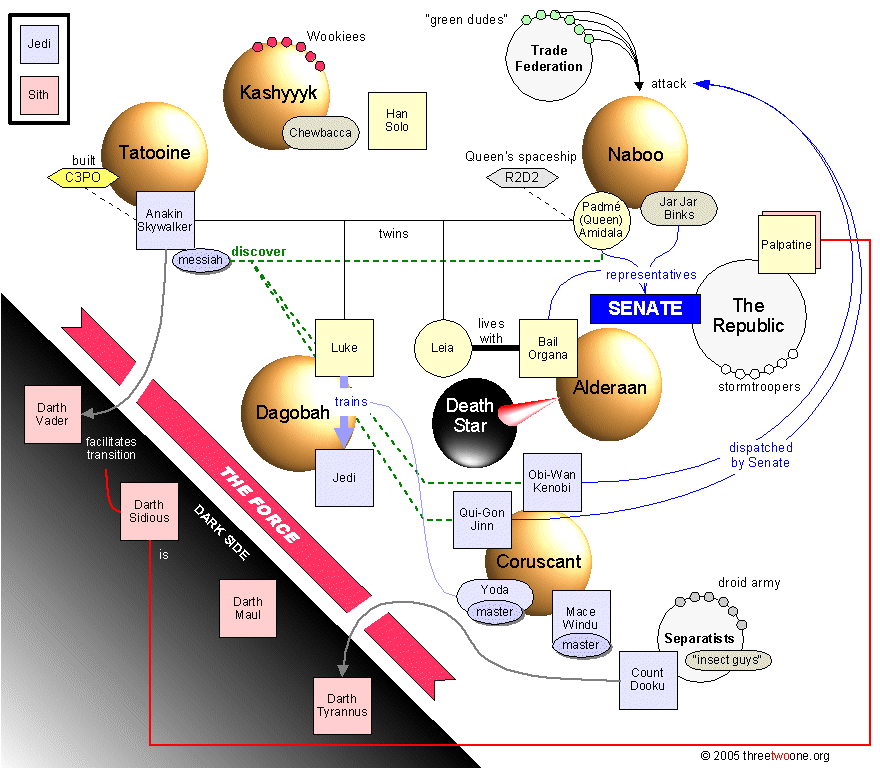
DNA & Acid
"FRANCIS CRICK, the Nobel Prize-winning father of modern genetics, was under the influence of LSD when he first deduced the double-helix structure of DNA nearly 50 years ago.
The abrasive and unorthodox Crick and his brilliant American co-researcher James Watson famously celebrated their eureka moment in March 1953 by running from the now legendary Cavendish Laboratory in Cambridge to the nearby Eagle pub, where they announced over pints of bitter that they had discovered the secret of life.
Crick, who died in 2004, aged 88, later told a fellow scientist that he often used small doses of LSD then an experimental drug used in psychotherapy to boost his powers of thought. He said it was LSD, not the Eagle's warm beer, that helped him to unravel the structure of DNA, the discovery that won him the Nobel Prize...
I visited Crick at his home, Golden Helix, in Cambridge. He listened with rapt, amused attention to what I told him about the role of LSD in his Nobel Prize-winning discovery. He gave no intimation of surprise. When I had finished, he said: 'Print a word of it and I'll sue.'"
read more
The abrasive and unorthodox Crick and his brilliant American co-researcher James Watson famously celebrated their eureka moment in March 1953 by running from the now legendary Cavendish Laboratory in Cambridge to the nearby Eagle pub, where they announced over pints of bitter that they had discovered the secret of life.
Crick, who died in 2004, aged 88, later told a fellow scientist that he often used small doses of LSD then an experimental drug used in psychotherapy to boost his powers of thought. He said it was LSD, not the Eagle's warm beer, that helped him to unravel the structure of DNA, the discovery that won him the Nobel Prize...
I visited Crick at his home, Golden Helix, in Cambridge. He listened with rapt, amused attention to what I told him about the role of LSD in his Nobel Prize-winning discovery. He gave no intimation of surprise. When I had finished, he said: 'Print a word of it and I'll sue.'"
read more
Wednesday, November 22, 2006
More on anthropology's role in US torture
"That report is consistent with a new book that shows how interrogation techniques by U.S. forces, which once focused on physical tactics, are increasingly focused on specific cultural aspects of people that may make them likely to break. “It’s clear that they are now focused on the idea of attacking cultural sensitivity” and are using anthropology and other social science research, said Alfred W. McCoy, a historian at the University of Wisconsin at Madison and the author of A Question of Torture: CIA Interrogation, From the Cold War to the War on Terror."
read more
read more
Tuesday, November 21, 2006
Simon Jennkins blasts Blair
"After 1990 many hoped that an age of stable peace might dawn. Rich nations might disarm and combine to help the poor, advancing the cause of global responsibility. Instead two of history's most internationalist states, America and Britain, have returned to the trough of conflict, chasing a chimera of "world terrorism", and at ludicrous expense. They have brought death and destruction to a part of the globe that posed no strategic threat. Now one of them, Tony Blair, stands in a patch of desert to claim that "world security in the 21st century" depends on which warlord controls it. Was anything so demented"
read more
read more
Murdoch - a predatory capitalist
"We are talking information here, and Murdoch controls a vast amount of the information that flows around the world, from China to California. As the OJ Simpson affair shows, he's a cultural, as well as political, gatekeeper. That's why, though we should worry about Branson, we should worry more about Murdoch. Branson also has a gigantic network of interests, but he's essentially a brand label that can be slapped on anything from jeans to jumbo jets, and doesn't have the same influence on how we perceive the world...
Murdoch is so much a part of the landscape that we sometimes lose sight of how outrageous his power is; we think his behaviour is just that of a natural businessman, as in some senses it is. But British political leaders cross the globe to pay him court, like tribal chiefs from outlying provinces offering tribute to a Roman emperor. He pays only the tax he feels like paying, which isn't much. To a remarkable extent, his political agenda - light business regulation, tight shackles on trade unions, a semi-detached status within the European Union, support for the American neocons in Iraq - is also the British political agenda."
read more
Murdoch is so much a part of the landscape that we sometimes lose sight of how outrageous his power is; we think his behaviour is just that of a natural businessman, as in some senses it is. But British political leaders cross the globe to pay him court, like tribal chiefs from outlying provinces offering tribute to a Roman emperor. He pays only the tax he feels like paying, which isn't much. To a remarkable extent, his political agenda - light business regulation, tight shackles on trade unions, a semi-detached status within the European Union, support for the American neocons in Iraq - is also the British political agenda."
read more
Lebanon
"In Washington, the killing appeared likely to strengthen the hands of those in the administration, led by the vice-president, Dick Cheney, who oppose negotiations with Syria or Iran over Iraq. The US ambassador to the UN, John Bolton, went further than Mr Bush in linking Syria and Iran to the killing.
"The White House warned about two weeks ago that Syria and Iran, acting through Hizbullah, might be on the verge of an attempted coup d'etat in Lebanon. One has to wonder whether this despicable assassination is not the first shot," Mr Bolton said.
Syria's ambassador to the UN, Bashar Jaafari, rejected the allegations. "We are part of the solution, not part of the problem," he said."
read more
"The White House warned about two weeks ago that Syria and Iran, acting through Hizbullah, might be on the verge of an attempted coup d'etat in Lebanon. One has to wonder whether this despicable assassination is not the first shot," Mr Bolton said.
Syria's ambassador to the UN, Bashar Jaafari, rejected the allegations. "We are part of the solution, not part of the problem," he said."
read more

Anthropologists [5yrs late] Stand Up Against Torture and the Occupation of Iraq
"Such resolutions rarely solve problems, but they do clarify group values and serve notice to those forces that are pressing to use anthropology for intelligence needs-but the sudden move to restore what was once an important democratic mechanism of a past era may signify that the members want greater control over where anthropology seems to be heading in the post 9/11 world."
read more
read more
Monday, November 20, 2006
Wednesday, November 15, 2006


Is change coming?
"There is a clue to how seminal this change of hands is in the power bases of the two relevant parties. The committee's outgoing Republican chairman, James Inhofe, comes from Oklahoma, bang in the heartland of America; in the plains, where farming, the gun and the pickup truck form a holy trinity.
The incoming Democrat, Barbara Boxer, comes from, yes, California, a state that has supplied several of the leaders of the Democrat revolution, including Nanci Pelosi of San Francisco, the new speaker of the House... Mr Inhofe has a track record for using his power in committee to block legislation designed to cut the greenhouse gas emissions contributing to climate change. He famously said on one occasion that global warming was "the greatest hoax perpetrated on the American people".
read more
The incoming Democrat, Barbara Boxer, comes from, yes, California, a state that has supplied several of the leaders of the Democrat revolution, including Nanci Pelosi of San Francisco, the new speaker of the House... Mr Inhofe has a track record for using his power in committee to block legislation designed to cut the greenhouse gas emissions contributing to climate change. He famously said on one occasion that global warming was "the greatest hoax perpetrated on the American people".
read more
Thursday, November 09, 2006
Jaffa Cake Lore

Pseudobiscuits
"The Jaffa Cake has long been a disputed member of the biscuit Order (Pootle, 2004). In his report “Jaffa Cakes are Cakes - Proof from the Courtroom”, Archibald (2004) describes a courtroom battle and the various evidences, leading to the decision of the British Government to classify the Jaffa Cakes as a cake, immunising Jaffa Cakes from VAT. Nicey and Wifey (2004b) leave no doubt that the Jaffa is clearly a cake. The following response is given on their website (Nicey and Wifey 2004a), to the frequently asked question: “Are Jaffa Cakes biscuits?”
“No, no they're not. Apart from being called cakes they obviously have a sponge base. Granted they appear to be some kind of luxury biscuit being chocolate covered and shipping in a box.” [italics added].
The argument that the word ‘cake’ appears in the name is a simple issue of semantics. Using this logic one may argue that shortcake is a cake. Objects are classified based on their appearance. According to the current analysis using parsimony, if the Jaffa Cake IS indeed a cake, then so are Fig Rolls and Jammie Dodgers (an unarguable situation). This is because these two biscuits show closer affinities with the Jaffa Cake than with any other biscuits. So according to this classification, the Jaffa cake IS a biscuit after all. It therefore seems there is no simple dichotomy between cakes and biscuits. However, it is possible to make a compromise between a biscuit and cake affinity for Jaffa cakes, by allocating this group a new name. I propose the name Pseudobiscuits for this clade of three genera, on account of their close kinship with both cakes and biscuits. All other biscuits, can be referred to as ‘true biscuits’."
Read more
Monday, November 06, 2006
Corruption Index
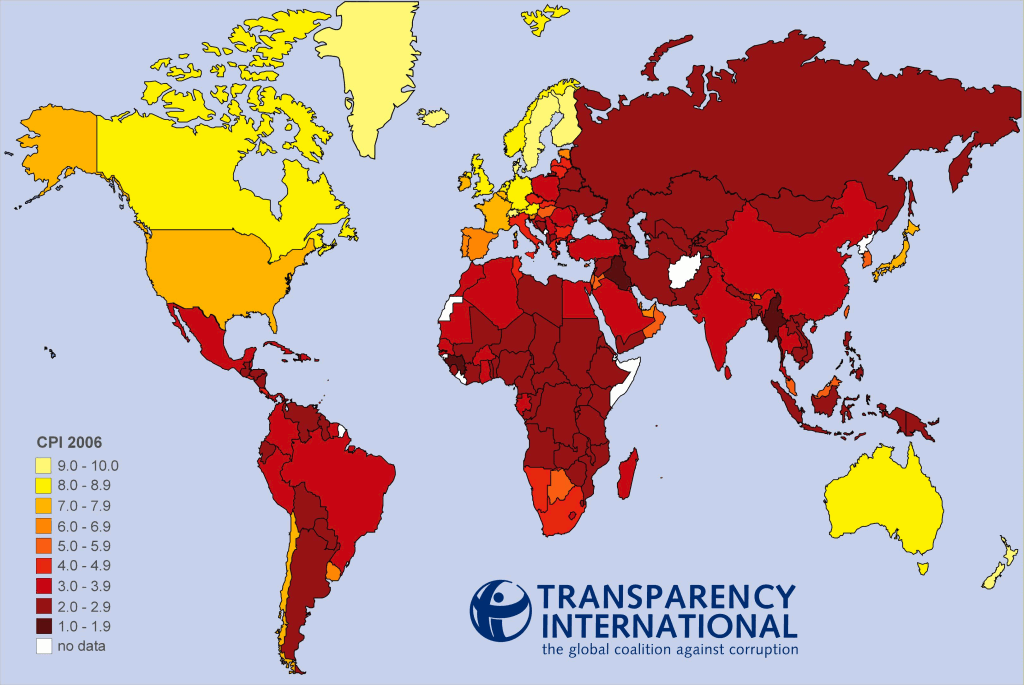
Yellow (had to ask someone the colour to be sure - but i was good) means less corrupt, red (maroon i'm told, looks kinda brown, but hey) more corrupt
The University of Passau (Germany) and Transparency International has just released their corruption index for 2005.
The index defines corruption as the abuse of public office for private gain and measures the degree to which corruption is perceived to exist among a country's public officials and politicians.
Countries that have improved their rating since the 2004 index were Argentina, Austria, Bolivia, Estonia, France, Guatemala, Honduras, Hong Kong, Japan, Jordan, Kazakhstan, Lebanon, Moldova, Nigeria, Qatar, Slovakia, South Korea, Taiwan, Turkey, Ukraine, and Yemen. Some of the countries that have a worse rating since 2004 include Brazil, Costa Rica, Gabon, Nepal, Papua New Guinea, Russia, Seychelles, Sri Lanka, Suriname and guess who TRINIDAD & TOBAGO.
Saturday, November 04, 2006
Recognition
"If at times she showed me these marks of affection, she pained me also by seeming not pleased to see me, and this happened often on the very days on which i had most counted on the realisation of my hopes." Proust, Swann's Way (1981 [1913):438)
ICC Final tomorrow 9am GMT
Australia as always have the mark of big-headedness. Ricky Ponting their captain says "We have probably won more one-day finals, one-day tournaments, and World Cups than any other team... certainly a lot more than the West Indies have. We know what it takes to win big games and we will see how the West Indian players will cope under pressure."
Umm, even if they've won more, they've never won this tournament and it is the West Indies who coped with the pressure last time round to currently be the tournament holders.
wouldnt it be good if......
Umm, even if they've won more, they've never won this tournament and it is the West Indies who coped with the pressure last time round to currently be the tournament holders.
wouldnt it be good if......
Friday, November 03, 2006
The net police
FC Copenhagen 1 – Manchester United 0 (Extended highlights here) "It's special - and not just because I'm a Liverpool fan" - Copenhagen coach, Stale Solbakken
from 101greatgoals
"The FA Premier League has ordered YouTube, the video-sharing website, to pull down clips of top-flight matches as it seeks to defend the value of television rights from erosion by online bootleggers."
more
We just link it - we don't host it
from 101greatgoals
"The FA Premier League has ordered YouTube, the video-sharing website, to pull down clips of top-flight matches as it seeks to defend the value of television rights from erosion by online bootleggers."
more
We just link it - we don't host it
Subscribe to:
Posts (Atom)